I have a few ideas for the heaters based on research photographs.
This plainer style heater would be perfect for the study in a monotone colour such as green or brown. It would have been a small room and not required a large heater - we could incorporate a repeated image representing death on the tiles.
The drawing room would have required a larger heater and was also the place that guests were brought to be entertained and therefore impressed. As social climbers the Ilyich's would have wanted the best that they could afford and so the design for this would be much grander.
The heater pictured here is neoclassical however the swags and tails are fantastic and would echo the curtaining.
This pair of heaters are from the interior of a russian palace and much too grand but the repeated love of blue and white delft (?) ware is common in a lot of the pictures I have seen and this could be brought into the front room in a simpler design.
Here are the quick sketches I have done for the two heaters.
The first echoes the design of the plain heater above and as I mentioned could have a repeated motif on each tile.
The second is a more simplified design of those I have seen in the palaces and could incorporate a swag and tail design or the blue and white tiles as shown in the pictures above.
Labels
- Essays (3)
- Film Reviews (6)
- Fine Art (1)
- Performing Object (27)
- Set Design (11)
- Work Experience (2)
Monday, 9 May 2011
Motifs in Design
The group has been considering incorporating motifs to represent death in a subtle way in the furniture of the study for Ivan Ilyich. I found an excellent source of inspiration for the different ways this could be done in the book Baroque: Style in the age of magnificence (2009) Edited by Michael Snodin and Nigel Llewellyn, Published by V & A Publishing, London
The following images are all from this book:
This mask from the fountain garden screen at Hampton Court, Jean Tijou. 1690 would look just as well as the back of a sofa or top of a chair.
The title of this painting is A Cabinet of Curiosities by Georg Hinz, Germany, 1666
It is a wonderful depiction of a collection of curiosities and might provide inspiration for either the bookshelf in the study or the cabinet in the drawing room.
Death depicted on a church floor in marble, infact death was a popular depiction to remind the faithful of the need for piety.
Floor relief Cornaro Chapel, Gianlorenzo Bernini, marble. Rome 1647-51
Time and Death is made of wax. Its main focus is on the corruption of the flesh. Its origins are not certain but possibly by Gaetano Zumbo or Zummo (1656-1701)
Very macabre and fitting for our story.
This picture shows a casket and a stand. The stand shows bacchanalian heads and vine work design on the legs. This could be easily incorporated into the occasional tables for the drawing room and study.
Stand attributed to William Vile, London, 1752
The following images are all from this book:
This mask from the fountain garden screen at Hampton Court, Jean Tijou. 1690 would look just as well as the back of a sofa or top of a chair.
The title of this painting is A Cabinet of Curiosities by Georg Hinz, Germany, 1666
It is a wonderful depiction of a collection of curiosities and might provide inspiration for either the bookshelf in the study or the cabinet in the drawing room.
Death depicted on a church floor in marble, infact death was a popular depiction to remind the faithful of the need for piety.
Floor relief Cornaro Chapel, Gianlorenzo Bernini, marble. Rome 1647-51
Time and Death is made of wax. Its main focus is on the corruption of the flesh. Its origins are not certain but possibly by Gaetano Zumbo or Zummo (1656-1701)
Very macabre and fitting for our story.
This picture shows a casket and a stand. The stand shows bacchanalian heads and vine work design on the legs. This could be easily incorporated into the occasional tables for the drawing room and study.
Stand attributed to William Vile, London, 1752
The Shining - Stanley Kubric (1980)
![]() |
| http://kriseyes.files.wordpress.com/2011/02/theshining19801.jpg |
The film is based on the novel of the same name, by Stephen King, about a writer with a wife and young son who accepts the job of off-season caretaker at an isolated hotel. He is a recovering alcoholic who stopped drinking because he hurt his son Danny. The hotel is built on an Indian burial ground and becomes isolated during winter. The manager warns him that a previous caretaker got cabin fever and killed his family and himself. The son, who possesses psychic abilities, is able to see things in the future or past, such as the ghosts in the hotel. Soon after moving in, and after a paralyzing winter storm that leaves the family snowbound, the father becomes influenced by the supernatural presence in the haunted hotel; he descends into madness and attempts to kill his wife and son.
This adaptation of a Stephen King novel is one I find genuinely disturbing. Having watched it when I was younger (late teens) and again as part of this project (early fourties) the film has not lessened its effect. In fact now I am a mother it has become worse - I am actually sitting at my computer as I write this, scared of the dark outside the door!!!!
The film deals with the subject of abuse and betrayal as well as the supernatural. Jack Torrences deterioration into madness only magnifies his personality (much as alcohol would do) by turning off his inhibitions. He has already hurt his son in a drunken episode, alluded to by his wife Wendy and when Danny shows up injured and visibly traumatized after going into room 237 Wendy's first thought is that Jack has been abusing Danny. It is clearly a habit of his to take out his frustrations at failing in life on someone else rather than face the fact he is to blame. The ghostly encounters he has at the hotel only reinforce these beliefs and the isolation ensures he can act on them.
His wife Wendy is portrayed as paradoxically very capable and at the same time very hysterical. She is obviously self sufficient in doing all the tasks at the hotel and entertaining both herself and her son but seems incapable of following her instincts and removing her son from danger when he starts to suffer from terrifying visions. Like wise when she is being attacked by her husband although she manages to fight him off on both instances it is preceeded with much screaming and ineffectual waving of weapons.
Neither parent is overly concerned their small child is roaming the kitchens, corridors and rooms of an extremely large hotel unsupervised. Indeed it is through the camera lens of Danny that most of the atmosphere is built. The long low shots of him riding his bike through corridors that telescope away into the distance are masterful, as your anxiety of what could happen to him builds, and his visions of the blood and gore connected with the hotel occur more and more frequently as his fathers sanity unravels. He is obviously not only a gifted child, both intellectually in outwitting his father and psychically, but a disturbed one and his mantra like utterances as the third party 'Tony' are both pitiful and frightening.
It is ultimately the musical score that best documents the deterioration. It jars your senses like nails on a blackboard and does not let you rest. Crescendos are mixed with whispers and the silent moments only serve to shred your nerves further as they wait for what will happen next.
The film does not make it clear if Jack is going mad or if there are ghostly presence's until he is released from the food store by the ghost of the previous caretaker. However I do not feel it is the supernatural element or the gory flashes of Danny's visions that make The Shining so powerful, it is the ultimate horror of the betrayal of trust a child has in its parents and the unnatural desire to kill your own that is the true horror.
The Man Without a Past - Aki Kaurismaki (2002)
![]() |
| http://www.optimumreleasing.com/dyn/manwithoutdvd.jpg |
"Since there is no hope left in the world, I tried to make a hopeful film without too much pessimism, because everything is kind of wrong nowadays." -- Aki Kaurismäki
Markku Peltola plays a welder who is beaten and robbed after stepping off a train to look for work in Helsinki. Referred to as M, he barely survives and loses all memory of his past. Without any material resources, he slowly picks up the pieces and restarts his life among homeless and eccentric squatters on the outskirts of the city. M has to rely on help from generous local residents and obtain charity from the local Salvation Army. In the process, he meets and falls in love with a dour Salvation Army worker named Irma (Kati Outinen).
Renting his quarters from a droll security guard, M acquires a "monstrous" dog named Hannibal, renovates a jukebox that plays American rock music and blues, then turns a bunch of square Salvation Army musicians into a rock band. In another incident, he is arrested as a suspect in a bank robbery only because he was in the bank at the time and could not verify his identity. He later meets with the newly compassionate bank robber, who asks M to use the money he took from his frozen account to pay back people who worked for him.
The Police finally track his identity down after his wife contacts them in response to posters and he returns home to discover that they are divorced and she has found another man. The film ends with M and Irma walking off hand in hand after he returns.
I found this film utterly charming to watch, it has a slow pace which allows the story to build in a simple way, much like a friendship. The actors deadpan delivery of their lines increase the humour contained in them and the touching search for love and compassion in the darkest of times is dealt with in a light way that reflects the modesty of the characters.
Moments of genius for me are contained in the insight into Irma shown in her first bedroom scene. An almost nun like cell is shown in a Salvation Army hostel in which Irma keeps her few possessions. She is dressed in a floor length modest nightgown and approaching her spartan iron bed with a thin mattress you expect her to sit and pray - instead she reaches out and turns on her radio and you hear not the expected Handel's Messiah but Rock and Roll!!
This theme recurs with great effect throughout the movie, another high point being the Salvation Army band crowded onto a sofa sitting opposite M while the jukebox plays Rock and Roll. One by one their feet start tapping and their hands start to drum the rhythm as though the music itself is catching, they are experiencing a musical Road to Damascus.
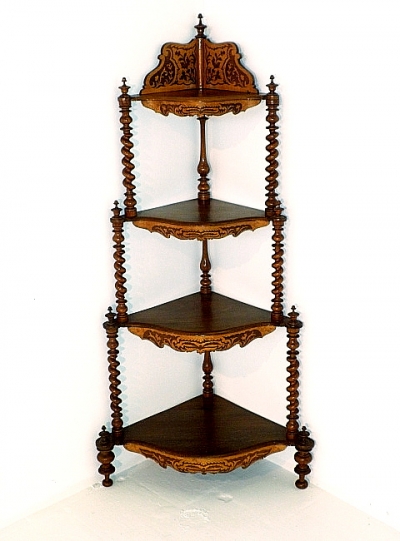
What is a what-not????
This quote from the book describes Ivan's view of his drawing room in his minds eye
"Looking at the yet unfinished drawing room he could see the fireplace, the screen, the what-not, the little chairs dotted here and there, the dishes and plates on the walls, and the bronzes, as they would be when everything was in place."
Most of this is crystal clear except a what-not???? So I googled it!!
A what-not is a piece of furniture derived from the French étagère, which was exceedingly popular in England in the first three-quarters of the 19th century. It usually consists of slender uprights or pillars, supporting a series of shelves for holding china, ornaments, trifles, or what not, hence the allusive name.
They could be plain or fancy as these pictures show and normally made from mahogany.
"Looking at the yet unfinished drawing room he could see the fireplace, the screen, the what-not, the little chairs dotted here and there, the dishes and plates on the walls, and the bronzes, as they would be when everything was in place."
Most of this is crystal clear except a what-not???? So I googled it!!
A what-not is a piece of furniture derived from the French étagère, which was exceedingly popular in England in the first three-quarters of the 19th century. It usually consists of slender uprights or pillars, supporting a series of shelves for holding china, ornaments, trifles, or what not, hence the allusive name.
They could be plain or fancy as these pictures show and normally made from mahogany.
Russian Fireplaces
I was intrigued to discover when doing the research for the interiors of Ivan's house that the fireplaces were not open ones but stoves. These were more efficient at using fuel and provided slow heat throughout the day.
This excerpt from a blog by Brian Kaller explains why they were used http://restoringmayberry.blogspot.com/2009/02/masonry-stoves.html
There is, however, a little-remembered method that was used in Central and Eastern Europe from the Middle Ages until the beginning of the fossil fuel era – the masonry stove. It relies on a simple concept: it is a hearth surrounded by a thermal mass like cob, brick or tile, which heats up with the fire and slowly releases heat throughout the day.
Instead of having a single vertical flue that takes the heat directly into the sky, masonry ovens have a flue that winds around several times before heading outside -- the smoke is typically cold by the time it reaches the outside. All the heat is transferred into the mass, and thence into the room.
Since the smoke and heat rise inside insulated ducts which do not conduct heat quickly, interior temperatures rise very high and hydrocarbon gases ignite as they do in a catalytic converter. Makers of masonry stoves claim their products are 85-90 percent efficient.
Fires in masonry ovens do not need to be tended and kept going, as it is not the fire itself that keeps the house warm but the thermal mass – most oven owners simply set one fire in the morning, and then let the heat radiate through the day. As they release the heat slowly, so they tend to be warm but not hot to the touch – some old Russian ovens were made with spaces on top for people to sleep where it was warm.
Perhaps most importantly, since the ovens need only a brief and quickly-burning fire, they do not require chopped wood for fuel, but can use faster-growing and more common material like straw or sticks. The fast-burning straw creates little soot to build up and block the flue, so their users say they require little cleaning.
Masonry ovens, like thatched roofs, bale-building and cob, is an old method recently revived when more people began to realize its advantages. If it takes off, millions of people could build sustainable heating systems out of nothing more than clay and stone, and heat themselves with material that is renewable and almost free.
For more information check out David Lyle’s excellent Book of Masonry Stoves, or a recent article on the subject by Low-Tech Magazine.
![]() |
| Russian Stove from St Petersburgh Palace |
This excerpt from a blog by Brian Kaller explains why they were used http://restoringmayberry.blogspot.com/2009/02/masonry-stoves.html
There is, however, a little-remembered method that was used in Central and Eastern Europe from the Middle Ages until the beginning of the fossil fuel era – the masonry stove. It relies on a simple concept: it is a hearth surrounded by a thermal mass like cob, brick or tile, which heats up with the fire and slowly releases heat throughout the day.
Instead of having a single vertical flue that takes the heat directly into the sky, masonry ovens have a flue that winds around several times before heading outside -- the smoke is typically cold by the time it reaches the outside. All the heat is transferred into the mass, and thence into the room.
Since the smoke and heat rise inside insulated ducts which do not conduct heat quickly, interior temperatures rise very high and hydrocarbon gases ignite as they do in a catalytic converter. Makers of masonry stoves claim their products are 85-90 percent efficient.
Fires in masonry ovens do not need to be tended and kept going, as it is not the fire itself that keeps the house warm but the thermal mass – most oven owners simply set one fire in the morning, and then let the heat radiate through the day. As they release the heat slowly, so they tend to be warm but not hot to the touch – some old Russian ovens were made with spaces on top for people to sleep where it was warm.
![]() |
| Image from annebobroffhajal.com |
Perhaps most importantly, since the ovens need only a brief and quickly-burning fire, they do not require chopped wood for fuel, but can use faster-growing and more common material like straw or sticks. The fast-burning straw creates little soot to build up and block the flue, so their users say they require little cleaning.
Masonry ovens, like thatched roofs, bale-building and cob, is an old method recently revived when more people began to realize its advantages. If it takes off, millions of people could build sustainable heating systems out of nothing more than clay and stone, and heat themselves with material that is renewable and almost free.
For more information check out David Lyle’s excellent Book of Masonry Stoves, or a recent article on the subject by Low-Tech Magazine.
Curtains and Drapes - 1886
A Plethora of Curtains and Drapery Styles - The Mid to Late Nineteenth Century
CurtainsThere was a proliferation of styles and revivals in Victorian interiors. One could find a “Gothic revival” portiere with a “neo-Rococo” lambrequin.
Curtains were generally hung from poles, and swags and tails were used liberally. In drawing rooms the curtains were often dress curtains (designed not to be drawn across the window) tied back on rosette-headed pins with sheers underneath. Decorative finials on the poles were an important part of the treatment. Everything was fringed, braided and bobbled.
![]() |
| Baroque style curtains |
The light was sometimes kept out altogether by the use of blinds. These were usually made of Holland linen (a type of canvas). Blinds were sometimes painted, bordered or self-patterned and trimmed with fringes or borders.
The lambrequin made a reappearance, the Victorian version being a flat pelmet with a shaped outline which continued down the side of the window, sometimes to the floor. It was originally intended to hide the bunches of fabric formed when a pull-up curtain was drawn above the window, but it soon became a treatment in its own right. It could be combined with symmetrical main curtains, and often also had an asymmetrical muslin curtain, caught back with different tie-backs. By the end of the century they were out of fashion, however, as they cut out too much light.
Carefully pleated curtain headings were still not common by the end of the century. However, it became fashionable for valances to have vertical pleats extending the depth of the valance or pelmet; these were used as an alternative to swags and tails. Goblet pleats were cup-shaped and padded.
Draped pelmets or valances would have been used where a flat lambrequin or pelmet would have been too severe.
![]() |
| Inside a Russian Palace |
Swags and tails were used on many bay windows of the period as they covered many awkward corners.
Scarf drapery, where one piece of fabric is draped to make a heading for a treatment, became fashionable. The Art Nouveau influence was apparent in the elaborate, asymmetrically arranged festoons.
![]() |
| Swags and tails |
Pelmets were seen in a variety of styles, including Grecian, Gothic, Elizabethan, Moorish and Louis XIV. By mid-century, stamped brass or richly gilded pelmet cornices were often placed on top of the fabric pelmets.
![]() |
| Pelmets from Chatsworth House |
Muslin curtains were still used to exclude insects and soften the light. White curtains were in vogue, and white cotton dimity was used extensively for bed curtains and counterpanes.
Portieres became popular, and were often double-sided, so that each fabric would harmonise with the colour scheme of the room it faced. Appliqué or embroidery were often used to divide them into the horizontal bands corresponding to the frieze, infill and dado of the adjacent walls.
In France, there were so many different styles of curtain that it was impossible to establish a characteristic one. Fabrics were draped over everything. Pelmets were shaped or deeply swagged. There were romantic curtains in tulle, muslin or dentelle frilled, beribboned, or “empearled”. Goblet pleats were used a great deal for the pelmets or portieres and stair curtains. There were curtains with heavy lambrequins, and there were liberal interpretations of other earlier styles.
Beds and Bed Hangings
Health and hygiene became one of the major concerns in the latter part of the 19th century, and heavy bed drapery came to be seen as unhealthy.
Simplicity was the key to Arts and Crafts beds, with the emphasis on the quality of fabric design. Plain cornice boxes in wood, painted or covered with a simple stiffened pelmet, were used with paired curtains. Sometimes the cornice boxes were omitted to show the curtains on their track.
Four-poster beds with plain curtains and a straight valance were a popular choice.
Fabrics
Mass production was the norm. The improvements in printing and dyeing over the previous 70 years had led to increased production of cotton goods. The idea of offering patterns in several different colourways had first appeared around 1820 and had become usual. There was a vast array of brilliantly coloured all-over printed cottons, and one- and two-colour unglazed cottons became relatively cheap in Britain.
During the 1840s there was a revival of interest in late 18th century designs. Victorian fabrics often had brown or black grounds and incorporated deep, rich colours in the design. From the middle of the century a number of new dyes were available for yellow, purple and blue-green.
The specialist textile industry in Marseilles, badly affected by the cheaper cottons available, declined rapidly.
![]() |
| Jacquard fabric |
In Britain, Jacquard looms produced an increasing amount of small-patterned wool damasks and moreen, a worsted cloth with a wood finish. Roller-printing grew, and soon dominated the textile industry, which used chemical dyes and a palette of colours inspired by Persian textiles.
![]() |
| Copy of damask fabric from Knole house |
Floral prints on cottons or cretonnes were popular in Victorian bedrooms, tartan and paisley patterns were widely used and lace was everywhere. Chintz remained fashionable until the end of the century. William Morris was very interested in textile design and favoured hand-blocked printing. Influenced by medieval art and Islamic, Persian and Italian Renaissance textiles, Morris believed that motifs from nature could be flattened and stylised.
There was a renewed interest in chinoiserie designs of peacocks and dragons, poppies, chrysanthemums and fruit trees in blossom. These fabrics were used to accompany the rich lacquerwork which was fashionable at this time.
![]() |
| Chinoiserie - Louis XV |
There was a vogue for all things Japanese following the reopening of Japanese ports of trade with the West in the 1890s. The Near East was also a major influence, with “Turkish corners” furnished with Near Eastern textiles such as ottoman velvets, prayer rugs and Turkish rugs covering cushions, window seats and divans.
In France, tulle muslin and dentelle were used for romantic-style curtains and bed draperies. Silk and damask decorated with flowers and exotic foliage were popular; the large flower designs dictated the way the fabrics were used.
Trimmings
Trimmings were rich and ornate. Braid was large and stylised with a variety of decorative motifs. Gimp braid with clusters of bobble fringe was fashionable.
Fringes were usually deep and topped with braids bearing geometric patterns or appliquéd flowers. There were ornate bullion or ball fringes. Persian fringe had a wide border supporting “teardrops”.
Tassel tops were arrow-head in shape or domed, with long skirts. Some tassels were severe and stylised, appliquéd with golden leaves or shells.
Contrasting linings, corded edges, dark silk fringing, embroidered panels and trompe l’oeil valances were all features of this period, and bell pulls with braided edges, appliquéd centres and tassels were very fashionable.
http://www.adriennechinn.co.uk/article12.htm
Subscribe to:
Posts (Atom)